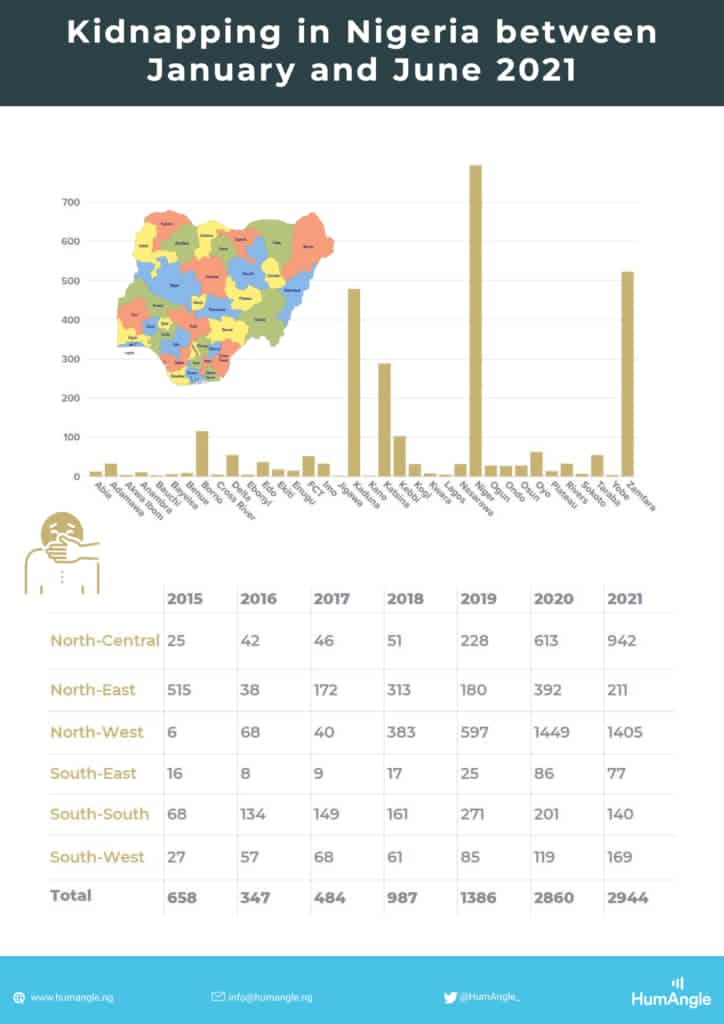
The statistics also show that mass abductions have increased dramatically and the burden of kidnapping, which used to be borne by the Northeast and South-south, has shifted to the Northwest and North-central regions.
Parents of students abducted at Bethel Baptist High School, Kaduna, July 9, 2021. REUTERS/Bosan Yakusak
The rate of kidnapping in Nigeria has more than doubled so far in 2021 compared to previous years, available data has shown.
By analysing data collected through the Nigeria Security Tracker (NST) between 2015 and June 2021, HumAngle observed a growing trend in the number of mass abductions as well as the total number of people who are victims of kidnapping in the country.
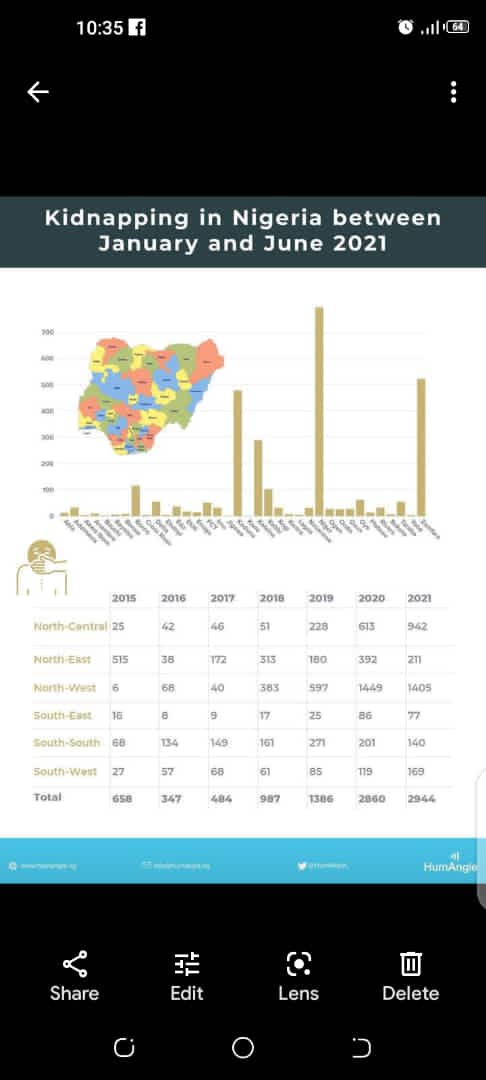
While in 2017, there were 484 kidnapping victims, the figure grew to 987 the following year, then 1,386 in 2019, and 2,860 in 2020.
Between Jan. 1 and June 30, this year, at least 2,944 people have already been reported kidnapped — making 2021 the worst year yet based on this security index. These numbers are higher if communities along the border areas in Cameroon, Chad, and the Niger Republic are taken into account.
The number of kidnapping incidents has increased too, from 110 in 2015 to 135 in 2016, 140 in 2017, 156 in 2018, 330 in 2019, 437 in 2020, and then 315 in the first half of 2021.
Another worrisome trend is the increase in the number of mass abductions. The average number of victims per incident has increased over the years from 2.6 in 2016 to 9.4 this year. While there were five abductions in 2015 with over 20 victims, Nigeria recorded 11 of such cases in 2018, eight in 2019, 25 in 2020, and 31 within the first six months of 2021.
Young people, especially those enrolled in school, are some of the commonest targets of these large-scale atrocities. This year alone, students have been kidnapped in their tens and hundreds in Kagara, Niger State; Jangebe in Zamfara State; Afaka in Kaduna State; and Yauri in Kebbi State.
A tally done by This Day Newspaper estimatesthat, as of March, over 618 schools had been closed in Northern Nigeria due to the frequent attacks and abduction of students. The affected states included Sokoto, Zamfara, Kano, Katsina, Niger, and Yobe.
The numbers from NST also show how the wave of kidnapping has shifted from one region to the other.
Back in 2015, the Northeast and South-south had the highest numbers of victims as a result of the Boko Haram insurgency in the former and acts of militancy in the latter. But, a few years down the line, especially in 2020 and 2021, the North-central and Northwest have now become the hardest-hit regions due to spreading terrorism and banditry.
This year, states in the Northwest had 1405 victims of kidnapping, followed by the North-central region (942), then Northeast (211), Southwest (169), South-south (140), and Southeast (77).
Growing insecurity in Nigeria has been attributed to alarming unemployment rates, the smuggling and circulation of small arms, as well as the understaffing and underequipping of security forces.
In a report published last year, research group SBM Intelligence described the problem as the “democratisation of the kidnap industry,” estimating that, between 2011 and 2020, at least $18.34 million was paid as ransom to kidnappers in the country.
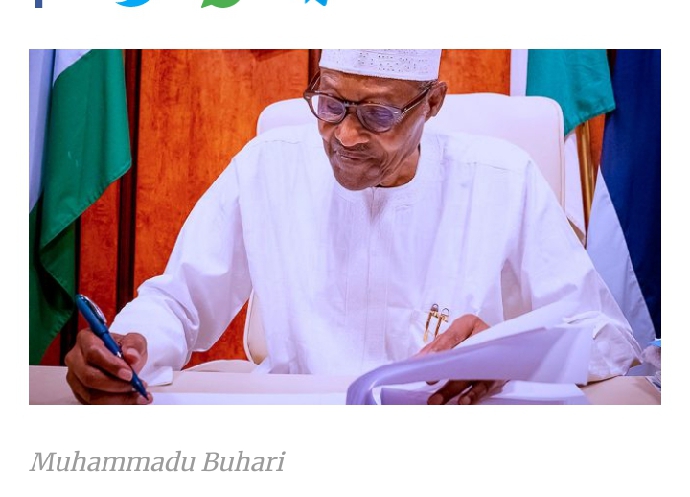
In a statement released on Sunday, June 11, Nigerian President Muhammadu Buhari urged the military to “respond to the worrying situation in a language that the bandits understand.” He added that the security agencies were working on new methods and policies that had started to yield positive results in the troubled regions. Available data, however, appears to disagree with this assessment.
A trouble is a private matter and occurs when values cherished by an individual are felt by him to be threatened, while issues have to do with matters that transcend the local environments of the individual. So when values cherished by the public are felt to be threatened, then there is an issue because that is a communal matter.
If only one man is unemployed in a city of 100,000, that is his personal trouble, and for a solution, we investigate the character of the person, his skills and his immediate opportunities, but when in a nation of 50 Million people we have 15 Million that are unemployed, that is an issue and we may not hope to find its solution within the range of opportunities open to any individual, this signifies that the very structure of opportunities has collapsed.
In the above scenario, both the correct statement of the problem and the range of possible solutions, require us to consider economic and political institutions of the society and not merely the personal situation and character of individuals.
In the early 20th century sociologists typically associated social problems such as unemployment, crime, poverty with deviant individuals. As a result when they sought to solve social problems, they focus on changing individual behaviour, although this approach is still alive today, sociologist had by and large arrived at a different understanding.
By the mid-century, sociologist turned away from an emphasis on individuals to a consideration of the social structures of nation’s organisations and institutions such as corporations, governments and the media for an understanding of the possible factors influencing social inequalities.
Sociologists has come to define social problems as problems that concern large numbers of people, have social structural causes, and require social-structural solutions. This approach remains fundamental to the sociological perspective. It was a step forward from the individualistic approach. Because by finally demonstrating that social problems have structural causes, sociologist helped to steer the people away from unproductive scape-goating of individuals to an awareness of the need for social change.
When a problem affects a large number of people, we must look beyond individuals to social structures-the larger economic, political, and social patterns of a society, we cannot solve the problems of a society that is structurally flawed by changing individuals one at a time.
We live in a world where people are increasingly interconnected and so are their problems, people in USA lose their jobs when factories are moved to nations where wages are lower. In Brazil people lose their homelands when the rain forests are cut down to make furniture for the world market, these are pointers to the need for one to look beyond what is being seen as a problem to determine its influencing factors.
For over a decade, Nigeria has been fraught with insecurity challenges, from Boko Haram and their ISWAP counterparts to Bandits and unknown gun men, in the midst of all this, the statistics of unemployed youths and graduates in the nation has been rising to an alarming rate, the basic development infrastructures like electricity to enhance the industrialization of the nation in order to create employment opportunities has been lacking, thereby crippling other efforts to drive the economic resurgence of the 7th most populous nation in the world.
It’s a fact that the issue of insecurity in the nation has invincible social sponsors like poverty and unemployment; these contributes to frustration and anger that can result to one taking to armed robbery, kidnapping or pitching tent with agitators calling for dissolution of the nation under the guise of revolutionaries thereby creating more panic in the society.
Leading nations of the world are undergoing a process of modernization, encompassing changes such as industrialization, urbanization, and growing social complexity in the modernization perspective. Insecurity in Nigeria and Imo are social problems inherent in Nigeria, and as a social problem, can be seen as failures in modernization. For example, in today’s world societies that fail to industrialize will be poor and conflict ridden. On an optimistic note, this perspective suggests that these problems can be solved through government intervention to lead society on the road to modernization.
So many of today’s social problems are global in nature, we cannot hope to solve them by focusing on individual nations, ISWAP that are recently credited with killing of Shekau the Boko Haram leader, is an offshoot of a globally recognised terrorist network.
On this premise, Senator Hope Uzodinma and other Governors facing insecurity challenges are also victims of the same circumstance with the people they govern, because the challenge cannot be resolved successfully by an individual, but with modernistic social approaches strong enough to trigger a paradigm shift among the populace, that can feed them with hope and dreams that are far better than for them resorting to violence.
The Nigerian government has to understand that insecurity in the nation requires a proactive economic plan, accompanied by a wealth of opportunities to help engage its people in productive activities that can help them to dream of a better tomorrow.
Prisons and Electric Chairs in nations like USA have not stopped the crimes associated with drugs and gun violence, so equipping Nigerian Military and Police Force with exotic weapons will not end insurgency faster than creating an enabling environment that will help the people to dream would.
The Insecurity in Imo and its concomitant hazards that has been successfully arrested as a situation was inherited from Nigeria by Senator Hope Uzodinma, the Unknown Gun-men issue is related to other inherent negative social factors in other parts of Nigeria as well as other nations outside of Nigeria.
The best he can do for Imo and his people is to create a wealth of opportunities like he is doing, recently he empowered 15,000 Imo youths with a seed of 250,000 Naira each, after completing their entrepreneurial skills. That is a good step in the right direction but will not end the issue until the entire political leadership of Nigeria accelerate the steps towards industrialization, and create not just opportunities but an enabling environment to help their people dream differently.
Insecurity in Nigeria is not a national problem as most people think but rather trans-national, Nigeria need to look beyond its borders for insurgents, as well as overhauling its economic plan to totally eliminate this visible and invisible enemy.
Senator Hope Uzodinma as Governor of Imo State is innocent just like every one of us that has not chosen violence, guns and grenades as means of conversing with our fellow Nigerians. Leadership sometimes comes with tough and unpleasant decisions and the Governor has not retreated from them having consistently chosen the ones that serve the interest and safety of Imo people first.
Before we start apportioning blames and looking for whom to fault for the uncertainties that has ravaged our communities in this short time, we need to remember that we are citizens in a global world that we do not control. Insecurity in Nigeria and Imo, are social problems that unemployment, poverty of opportunities and lack of basic amenities to enhance the survival of an individual will remain its unseen sponsors.
It is not uncommon for Nigerians to interchangeably use the word kidnap with the word hostage. Without wasting much time, and to keep it simple, kidnapping refers to a confinement without holding the legal authority to do so, while hostage refers to a person or entity which is held by a captor as a security. The word kidnap is associated with the activity in which a person is taken away usually against the person’s will. This is usually done for ransom.
Child kidnapping has become a threat to many countries in the world, especially in Nigeria, as children are innocent and viewed as easy targets by kidnappers. For instance, in July, 2021, about 140 students were kidnapped from a Baptist high school for ransom in northwest Kaduna. Also, in September 2021, about 73 students were abducted from a state-run high school in Zamfara’s Maradun district.
Furthermore, it is traumatizing to even imagine that children are unsafe in their place of learning. It is also important to state that kidnapping for ransom in Nigeria cuts across all groups and classes.
Major solutions to the challenges posed by the crime of kidnapping in Nigeria. First, establishing effective border control for all of Nigeria, especially in the North. Second, provisions of a reliable and unique identification number for each individual, for tracking social benefits other identification purposes. Third, curbing corruption within and among Nigerian law enforcement agencies. Fourth, creating a better relationship between the locals and Nigerian law enforcement agencies. The fifth solution, and chief of all my logical solutions is cutting off the logistics of kidnappers in Nigeria.
One of the major security challenges that the Nigerian states are facing in its fight against terrorism, and ransom kidnapping to be specific, is that Nigeria borders Niger Republic and Chad in the North, with Niger Republic and Chad bordering Libya in the south. Since the fall of Muammar Gaddafi on October 20, 2011, there are a great deal of guns, arms and ammunitions circulating the sub-region. This factor, coupled with the high rate of unemployment and jobless youths in the sub-region, are migrating into Nigeria, using their weapons and the slight combat training they acquired to create insecurity in Nigeria by kidnapping Nigerians for ransom.
It is important to state that this foreigner cannot be successful with their operations, without the support of some Nigerian citizens themselves. Commodore Jamila Malafa, the director of legal services in the Nigerian Navy has alleged the Chadian soldiers of selling AK47 guns to Nigerians for as low as twenty dollars as a result of the lack of armories in Chad and Niger Republic. These countries have received arms and ammunitions donated by the developed world to aid in counterterrorism. Top Nigerian military officers have also suggested that the Nigerian government may need to build walls and implement other security measures to secure the borders in Northern Nigeria.
It is unfathomable that Nigeria is still faced with the challenges of consistently identifying Nigerian citizens. Many efforts with little success have been made to solve these identification issues, ranging from the National ID card, bank verification numbers, voter registration cards, driver’s license and now the National Identification numbers, also known as NIN.
The ability to properly identify citizens will also give way to weed out illegal immigrants who cannot properly identify themselves. This has worked effectively in advanced countries of the world in their fight against crime. For instance, in the United States, your information is attached to your Social Security number. It is worth mentioning that the identification numbers are not for identifying criminals alone – it can be used for social benefits, such as assisting Nigerian citizens during and after the COVID-19 pandemic.
There are many allegations and convictions of corruption within and among Nigerian law enforcement agencies. This single act makes Nigerian citizens lose confidence in their law enforcement agents. Some of them have been accused of stealing money that was allotted to buy arms and ammunitions to fight terrorism in North-East Nigeria, while others have been alleged of selling and lending arms to criminals. If the corruption within and among the few Nigerian law enforcement agencies are tackled, the problem of terrorism and kidnapping for ransom are a quarter of the way dealt with. This will in turn restore the confidence in Nigerians by feeding law enforcement agencies the necessary information to tackle kidnapping for ransom. It is important to state that many Nigerian law enforcement agencies are doing the right thing by putting their lives on the line, but unfortunately, bad news spreads faster than good news. Whichever way you look at it, they deserve to be thanked for their service. In the United States of America as a police officer, police work is difficult without the support of the community or the locals. The fact is that most crimes are not committed in the presence of an officer, it is the community that often gives important information to the law enforcement agencies that makes the police work easier.
In relation Nigeria’s present situation, the Nigerian government should establish dedicated community policing, therefore creating a better relationship with the local traditional leaders, religious leaders, youths, and other social organizations within communities in Nigeria. By doing so, it will aid in curbing the problem of kidnapping in Nigeria as trust is established between the community and with law enforcement being consistent and available when kidnapping incidents arise.
Lastly, the logical solutions is to cut off the logistics of the kidnappers in Nigeria. This sounds simple and weird right? It is an indisputable fact that the logistics of the kidnappers are still flowing, allowing them to continue to carry out their nefarious acts of kidnapping for ransom. The more money that they make, the more sophisticated their weapons will be, and the more the kidnapping business will attract the younger generations.
It is essential to note that the Nigerian government under the current administration locked Nigerian land borders in 2019, with security being a major reason for closing the borders. This act was aimed at cutting off the logistics of terrorism in Nigeria, which include kidnapping for ransom. It will be subjective to justify that it had no positive effect in cutting at least some of the logistics of terrorism in the country, however – this government was focused on international logistics. I will call the attention of the law enforcement agencies on the local logistics – examples include understanding how the kidnappers get their supplies, how they obtain food and water, arms and ammunitions, telephones and other means of communication, how they gather information about their victims, and means of transportation.
In summary, as a logistics officer in more than 18 countries, I strongly believe that if all the aforementioned logistics to the kidnappers are cut off, that will be the end of kidnapping for ransom in Nigeria, as it will aid Nigerian law enforcement agencies to capture criminals that are about to commit these acts within Nigeria. It is also important to emphasize that cutting off the logistics to kidnappers alone is not the only solution to end kidnapping for ransom issues in Nigeria.
Successful solutions include combining effective control of all the Nigerian borders, especially in Northern Nigeria, while providing a reliable and unique identification number for each individual. As mentioned before, curbing corruption within and among Nigerian law enforcement agencies, and creating a better relationship between the locals and the Nigerian law enforcement agencies will aid in decreasing the incidence of kidnapping for ransom. Terrorists are constantly changing their tactics in sources for income, creating fear and anxiety in Nigeria. The Nigerian government and law enforcement agencies must quickly adapt to these terrorists’ tactics by changing strategies so that Nigeria can be a peaceful place to live
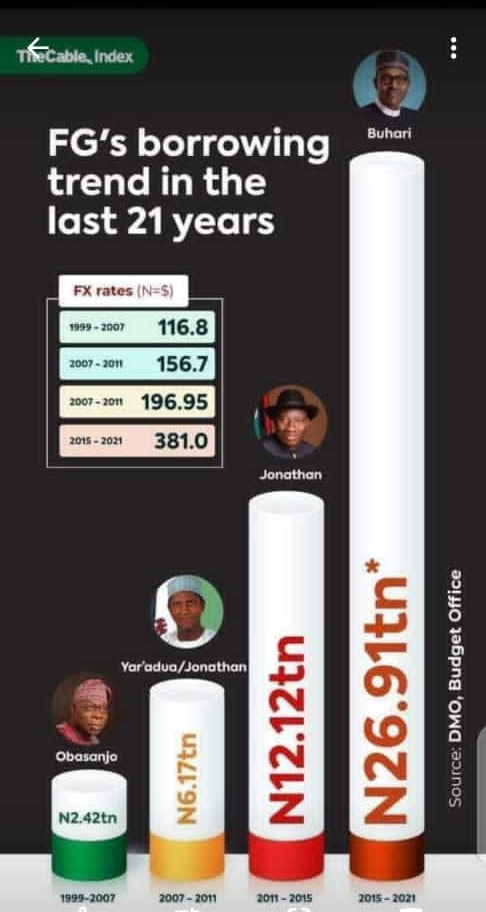
Amid concerns over debt overhang, President Muhammadu Buhari has requested the Senate to consider and approve an external borrowing plan amounting to about N2.5 trillion to fund projects captured under the 2018-2021 borrowing projections. If approved, the country’s documented national debts will balloon to over N35 trillion.
The Senate President, Ahmad Lawan, read the letter dated August 24, 2021, during plenary in Abuja, yesterday.
Buhari, in the letter, explained that the projects listed in the 2018-2021 Federal Government Borrowing Plan were to be financed through sovereign loans from the World Bank, French Development Agency (AFD), Export-Import Bank of China, International Fund for Agricultural Development (IFAD), Credit Suisse Group and Standard Chartered/China Export and Credit (SINOSURE).
The amount is in the sum of $4.05 billion, €710 million and a grant component of $125 million. The money, the President explained, would be used to fund federal and state government projects across key sectors such as infrastructure, health, agriculture and food security, energy, education and human capital development, as well as the COVID-19 response initiative.
Despite mounting debt, official documents reviewed by The Guardian suggest that the Federal Government is aggressively pursuing a longer-term debt programme that will push the maturity of currently-secured loans to between 10 and 30 years.
Refinancing short-term loans, according to the official documents, has become a strategic part of the current national debt management approach.
Whereas there is no official information of the portion of matured debts that are being refinanced, a professor of applied economics and debt management consultant, Godwin Owoh, said it would be in the region of 85 per cent.
The Debt Management Office (DMO), in the 2019 Annual Report and Statement of accounts released yesterday, admitted that short-term loan refinancing with longer-term aligns with the 2016 – 2019 Medium-Term Debt Management Strategy and that its achievement in that context is a major improvement on the debt management approach.
“The strategy of borrowing long, and restructuring of the domestic debt portfolio by refinancing matured treasury bills with longer tenor securities lengthened the Federal Government bond yield curve up to 30 years within the period and was critical to the successes recorded,” DMO said in the appraisal.
Top in the DMO agenda is keeping the average time-to-maturity (ATM) for the total public debt portfolio at a minimum of 10 years.
In principle, long-term loans are recommended for growing entities that aspire for stable planning and growth. But experts are worried that extending the maturing dates of Nigerian debts is tantamount to postponing the proverbial evil day.
This is as it came to light on Monday that the Federal Government committed a total of N11.679 trillion into debt servicing, while N8.31 trillion was expended on capital/development expenditure between 2015 and 2020.
A breakdown of the amount showed that in 2015 and 2016, N953.620 billion and N1.475 trillion, respectively, were spent on debt service, while N1.841 trillion and N2.203 trillion went into same line item in 2017 and 2018, respectively.
The figures were unveiled in the “Analysis of the 2022-2024 Medium Term Expenditure Framework and Fiscal Strategy Paper,” presented in Abuja by the Centre for Social Justice (CSJ).
The sums of N2.254 trillion and N2.951 trillion went into debt service in 2019 and 2020, respectively. The N11.679,845,205, 997 five-year debt service profile (2015-2020) also translated to a yearly average of N1.386 trillion.
At the presentation, the Lead Director of CSJ, Eze Onyekpere, whose organisation has been in the forefront of the campaign for fiscal discipline and transparency in public affairs, stated that Nigeria’s debt had also been increasing in double digits year-after-year since 2015, with the highest increase recorded between 2015 and 2016.
Citing DMO statistics, Onyekpere observed that public debt stock stood at N12,603 trillion in 2015, N17.360 trillion in 2016, and N21.725 trillion in 2017. In 2018, 2019 and 2020, public debt stood at N24.387 trillion, N27.401 trillion, and N32.915 trillion, respectively.
The highest increase occurred between 2015 and 2016. Between 2015 and 2020, Nigeria’s public debt increased by 161 per cent, indicating a yearly average increase of 37.74 per cent.
YESTERDAY, a financial expert and economist, David Adonri, said the government, by its tendency towards fresh debts, “is mortgaging the future of the country”.
His concern, like every other critic of the unbridled debt appetite of the current administration, is anchored on the poor investment in human and physical infrastructure.
Nigeria currently sits on the bottom of the global Human Capital Index. Its per capita investments in health and education – two critical sectors that grow human capital – is among the lowest in Africa, with South Africa and Egypt, its key economic competitors, far ahead.
Dr. Muda Yusuf, an economist and former director-general of the Lagos Chamber of Commerce and Industry (LCCI), said the growing stock of debt is a cause for concern as the cost of servicing it is unsustainable.
“The current levels of debt are already at an unsustainable threshold. If over 80 per cent of revenue is used to service debt, then it is about time to slow down on debt accumulation. From reports, this request is new, as it was not covered in the original borrowing. It is an addendum to the original plan, which had already been approved.
“Of course, there is merit in borrowing for infrastructure development, but even at that, the capacity to service the debt sustainably should be a critical consideration. The risk is that at this rate, part of the borrowing will inevitably be used to fund recurrent expenditure. Already, actual revenue can hardly cover the recurrent budget. The risk of ending up in a debt trap is quite high.”
The government’s current revenue profile is, indeed, abysmally low even as the future doesn’t look bright. The state governments are up in arms over who controls the value-added tax (VAT), which is the government’s major cash cow. Rivers State had won in litigation while the Federal Inland Revenue Service (FIRS) appealed and lost in its bid to secure a stay of execution.
If the Supreme Court rules in favour of states, the Federal Government could lose a substantial part of its earnings to states. This could worsen its fiscal position and impact its ability to service or repay debts. THE opposition Peoples Democratic Party (PDP) has rejected moves by the President Buhari-led All Progressives Congress (APC) administration to further mortgage Nigeria with a fresh N2.66 trillion ($4 billion and €710 million) external loan. The party expressed fears that “with the reckless borrowing by President Buhari and the APC, Nigerians might eventually not have a nation and a patrimony that they can freely call their own, after the APC, which has less than two years to vacate office, leaves government.”
The PDP lamented that with the N33.107 trillion debt already accumulated by President Buhari and the APC, an addition of N5.62 trillion borrowing proposed by Buhari for the 2022 budget and now a fresh N2.66 trillion external loan, the APC will be hanging N40 trillion debt on the nation, with no clear-cut repayment plan.
A statement by the National Publicity Secretary of PDP, Kola Ologbondiyan, raised the alarm that “the debts that APC is hanging on Nigerians are for nebulous projects, whose scope, utilities, locations and contractors are largely vague; a development that validates apprehensions of a huge swindle on our nation at the expense of innocent Nigerians, including generation yet unborn.”
The statement reads: “Our party holds it as an act of wickedness that individuals who know that they will be leaving office in less than two years will be accumulating debts instead of seeking ways to reduce the liability they have brought upon our nation.
“The APC knows it will not be around after May 29, 2023. That is why it is pushing our nation into deeper economic quagmire with foreign loans, which are largely diverted to personal pockets of their corrupt leaders.”
The PDP noted that “given their incompetence, corruption and manifest nonchalant attitude to the plights of Nigerians, the APC and its administration have not shown any commitment towards wealth creation as expected of any responsible government.
“Rather, they have resorted to reckless borrowing, pillaging of our national vault and suppression of our productive sectors; a development that have crippled our Gross Domestic Produce (GDP) to the extent that our naira, which the PDP handed over to the APC at N167 to a dollar, has now collapsed to a dismal and all-time low of N557 to a dollar under the APC.”
The PDP called on the National Assembly to save the nation by rising above partisan sentiments to reject this latest request by President Buhari for a fresh foreign loan.
The party also urged the National Assembly to immediately “commence an open investigative hearing on all the loans collected by President Buhari.”
The President, in the fresh request, claimed projects to be funded with the fresh loans across the six geo-political zones of the country would bring about employment generation and poverty reduction as well as protection of the most vulnerable.
MEANWHILE, Lagos State has become the first sub-national government to activate the framework for unlocking of the $1 trillion Nigerian Green Bond Market Development Programme to finance key infrastructure projects. Governor Babajide Sanwo-Olu, yesterday, signed a Memorandum of Understanding (MoU) with FMDQ Group and Financial Sector Deepening (FSD) Africa, which are the programme’s implementing partners on the proposed N25 billion (over $60 million) financing.
In a statement, the event, held at the State House in Marina, came less than 24 hours after Lagos was upgraded to AAA(nga) rating from AA+(nga) by Fitch International for the state’s good standing on debt sustainability and resilience.
Sanwo-Olu said the green bond programme, being supported by the UK Agency for International Development (UK Aid), would raise the capacity of the state to deliver more key infrastructure and social projects that would keep Lagos on the path of prosperity.
Launched in 2018, the Green Bond Market Development Programme is to facilitate development of a green bond market to support broader debt capital markets reforms that will impact the sovereign and non-sovereign bond markets in the country.
Sanwo-Olu said the MoU was the crucial first step being taken by Lagos towards creating viable financing option for future green and sustainability projects. The funding opportunity, he said, will advance adoption of innovation and technologies to provide green jobs, thereby promoting economic and climate resiliency.
Commissioner for Finance, Dr. Rabiu Olowo, said Lagos had 20 years experience in raising bonds, assuring implementing partners and capital market operators of the state’s commitment to the terms highlighted in the framework.
Chief Executive Officer of FMDQ Group, Mr. Bola Onadele, said Lagos had built reputation and “incredible potential” for catalysing broad-based sustainable development, which explained the partners’ readiness to support the State in unlocking the capital to fund key projects
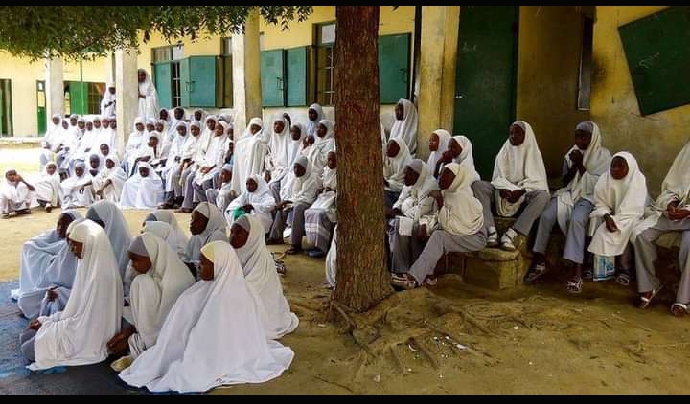
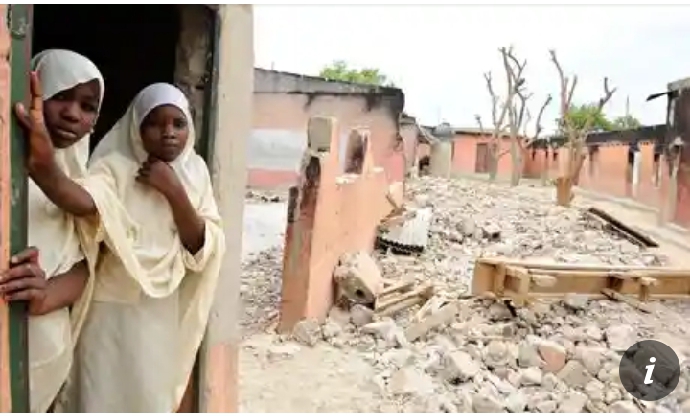
Despite the plight of more than 200 abducted Nigerian schoolgirls grabbing the world’s attention, their remain insufficient focus on the wider issues of education and gender politics in African’s most populous country.
Nigeria has the highest number of children out of school. The majority of non attendees are girls, mainly in the majority Muslim north.
In regions where women have lower school status many parents opt to send their girls to work in market rather than to go to school. A lack of education vastly reduces a child’s chances of escaping poverty and has led to many girls becoming wives before their 16th birthday.
The bride price a family can command for their daughter is seldom linked to her educational achievement, some parents see no incentive in sending their girls to school. These worrying attitudes are exacerbated by some religious leaders, who argue that educating girls is un-islamic.
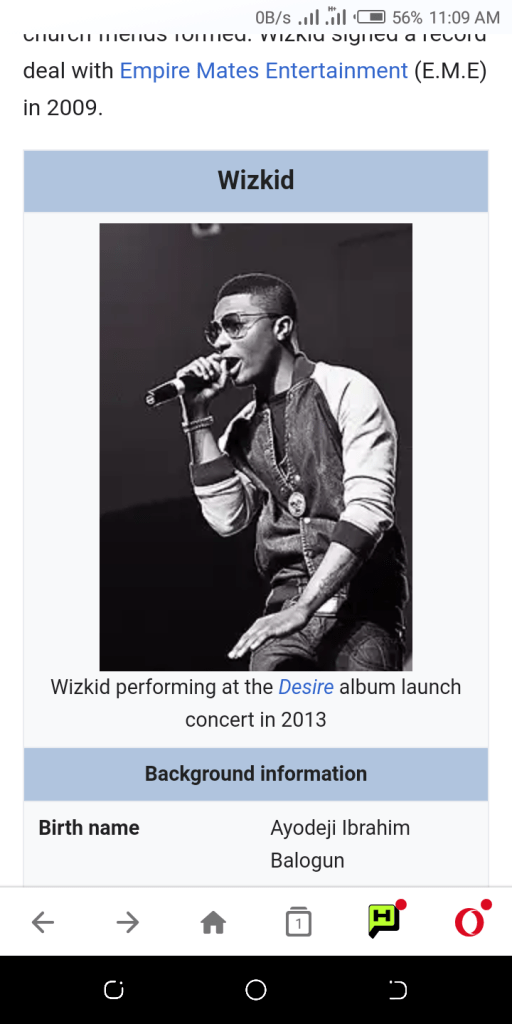
Ayodeji Ibrahim Balogun (born 16 July 1990), known professionally as Wizkid is a Nigerian singer and songwriter. He began recording music at the age of 11 and managed to release a collaborative album with the Glorious Five, a group he and a couple of his church friends formed. Wizkid signed a record deal with Empire Mates Entertainment (E.M.E) in 2009.Ayodeji Ibrahim Balogun (born 16 July 1990), known professionally as Wizkid is a Nigerian singer and songwriter. He began recording music at the age of 11 and managed to release a collaborative album with the Glorious Five, a group he and a couple of his church friends formed. Wizkid signed a record deal with Empire Mates Entertainment (E.M.E) in 2009.Ayodeji Ibrahim Balogun (born 16 July 1990), known professionally as Wizkid is a Nigerian singer and songwriter. He began recording music at the age of 11 and managed to release a collaborative album with the Glorious Five, a group he and a couple of his church friends formed. Wizkid signed a record deal with Empire Mates Entertainment (E.M.E) in 2009.Ayodeji Ibrahim Balogun (born 16 July 1990), known professionally as Wizkid is a Nigerian singer and songwriter. He began recording music at the age of 11 and managed to release a collaborative album with the Glorious Five, a group he and a couple of his church friends formed. Wizkid signed a record deal with Empire Mates Entertainment (E.M.E) in 2009.

 Site Title